


No Bathroom? Not a Problem
No bathroom? That isn't always a bad thing. Many campers don't have them. You might drive a converted Mercedes Sprinter, a Ford Transit, or a truck camper. If so, you already know the trade-off. You gave up a built-in black water tank. In return, you gained better mobility and a lighter vehicle. You can even park in a standard garage.
But now you face a real problem. Imagine it is 2:00 AM. You are parked in a Walmart lot. Or perhaps you are stuck in the mountains during a blizzard. Where do you go to the bathroom?
Here is the truth most RV guides won’t tell you: traditional RV toilet advice doesn’t apply to you. Those guides assume you have a dedicated bathroom space, existing plumbing, and a dumpable black water tank. They talk about "replacing"—swapping an old Dometic for a new composting toilet. But you aren't replacing anything. You are starting from zero, and that completely changes the definition of "best."
Table of Contents
This article is for campers who need to add a toilet to a space that doesn’t have one. No drilling holes in the floor, no installing exhaust fans, and no permanently sacrificing storage for a fixture you only use twice a day.
We will break down the best sanitary solutions by vehicle type—because the toilet that works for a 40-foot Class A motorhome is completely unsuitable for a Ford Transit conversion, which in turn is vastly different from the needs of a pop-up tent trailer. Whether you need to stealth camp in an urban environment, rattle down Forest Service washboard roads, or keep your tow weight under 2,000 lbs, there is a specific solution for your constraints.
Why Your Vehicle Decides Your Toilet Choice
The Reality of Weight
A fully loaded cassette toilet system weighs 35–40 lbs (approx. 16–18 kg). It might not sound like much, but if you’re driving a pop-up camper with a payload capacity of only 800 lbs (approx. 360 kg), that toilet takes up 5% of your total capacity. In a truck camper, every pound affects the center of gravity and fuel economy. Weight isn't just a matter of convenience—it’s a matter of safety.
Space Constraints vs. Usage Patterns
People living the Class B life calculate space in square inches, not square feet. The difference between a storable toilet occupying an 18" x 18" (46 x 46 cm) footprint and a toilet requiring a permanent 24" x 30" (61 x 76 cm) wet bath is the difference between having a kitchen counter or not. Meanwhile, off-roaders need systems that can survive violent jolts. Pop-up camper owners need toilets that disappear completely when the roof is lowered. These aren't just preferences; they are hard functional requirements dictated by the vehicle’s structure.

The Myth of "Installation"
Assume you are willing to modify your vehicle: cutting vents, reinforcing floors for heavy composting toilets, and wiring 12V fans. But if you are renting, planning to sell your truck bed camper later, or simply don't want to compromise the vehicle's integrity, a zero-installation solution isn't just "nice to have"—it’s mandatory. This requirement immediately disqualifies 80% of the "best RV toilets" recommended on general RV blogs.
Class B Vans: The Challenge of Stealth and Space Efficiency
Target Vehicles: Mercedes Sprinter, Ford Transit, RAM ProMaster conversions
Unique Constraints
You live in 60–80 square feet (approx. 5.6–7.4 square meters). Your "bathroom" might be a wet bath combo, a closet, or—to be honest—a curtain around a portable toilet. But unlike a pop-up camper, you might actually sleep in your van in downtown Seattle. When stealth camping on city streets, the hum of an exhaust fan or the odor of a chemical toilet could lead to a security guard knocking on your door.
Regarding space, you usually only have 18–24 inches (46–61 cm) of clearance under bed storage or limited depth in a bench seat. Any toilet solution must either fit these cramped spaces or serve a dual purpose (like a toilet that doubles as a seat, though most find that... uncomfortable).
Why Traditional Options Fail Here
Composting toilets require cutting a hole in the roof or sidewall for a vent pipe. In a van, this causes three problems: it ruins your stealth appearance (a roof vent is a "someone lives here" sign), it creates a thermal bridge in your insulation, and it permanently occupies floor space.
Cassette toilets look tempting until you realize the "portable" tank weighs over 20 lbs (9+ kg) when full, and you have to carry it through your living space to dump it. Furthermore, the chemical additives needed to manage odor create that distinct "porta-potty" smell that lingers in small spaces.
The Solution: Under-bed Dry Flush Sealing Toilets
For Class B conversions, dry-seal toilets (such as Modiwell) represent the dream solution for stealth campers.
Here are the specific advantages for vans:
- Zero External Venting: No holes in the roof. Waste is physically sealed in specialized bagging material to lock in odors, rather than using chemicals or ventilation. This means you can keep used collection bags under the bed for days without odors escaping—crucial when city camping without immediate access to a dump station.
- Spatial Form: Small enough to slide into a bed platform or tuck into a cabinet. Pull it out when needed, disappear it when not.
- Weight Distribution: Lightweight when empty. Waste is contained in independent sealed bags that can be removed individually. You no longer have to lift a 30 lb (14 kg) sloshing tank through your kitchen to find a dump station.
- Urban Disposal: This is a game-changer. In a van, you are often far from RV dump stations. But you can always find a trash can. Dry seal bag systems, in most areas, follow the same disposal logic as baby diapers and are considered standard municipal solid waste.
Pop-Ups and A-Frame Campers: Weight-Sensitive Choices
Target Vehicles: Forest River Flagstaff, Jayco Jay Series, Aliner, Coachmen Clipper
Payload Anxiety is Real
Pop-up campers are engineering marvels—until you start loading them. Most have a Cargo Carrying Capacity (CCC) of only 800–1,200 lbs (360–540 kg). This must include your bedding, kitchen gear, water, bikes, and your toilet.
A traditional cassette toilet weighs 25 lbs (11 kg) empty. Add 5 gallons (19 liters) of water/chemicals (water weighs 8.3 lbs per gallon), and you’ve contributed 65–70 lbs (29–32 kg) to your precious payload. For a camper with a dry weight of 2,000 lbs (907 kg), this is unacceptable.
The Folding Factor
Here is a constraint that eliminates most fixed options: you must completely clear the interior when the roof is lowered. The toilet has to come out every time you pack up camp. If it’s heavy, bulky, or requires disconnecting lines (even just a vent), you will hate your life by the third day of the trip.
Why Dry Flush Toilets Dominate This Category
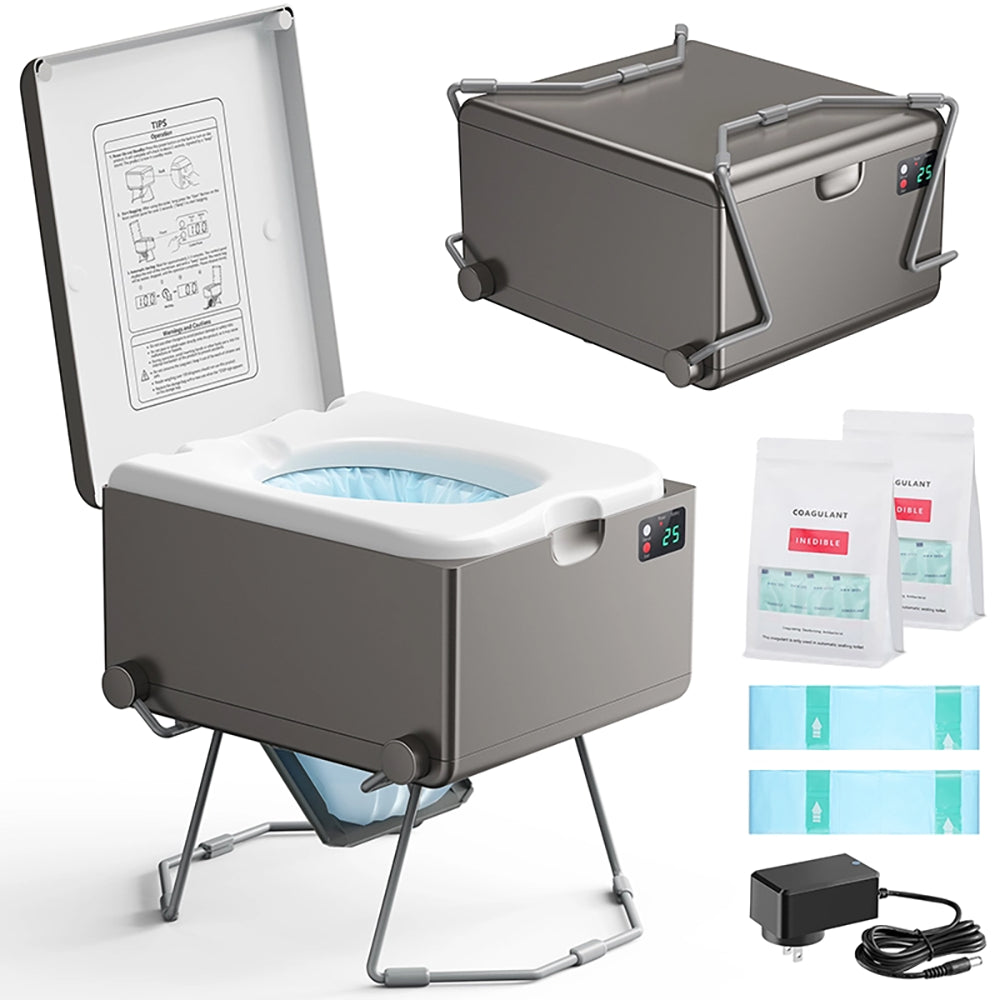
- Weight Savings: A Modiwell LE-310 dry flush toilet weighs about 17 lbs. The added weight of the bagging material is negligible. A wet cassette toilet can exceed 60 lbs (27+ kg). On a pop-up camper’s suspension, this difference is massive.
- Collapsibility: When empty, bag-style systems take up very little space. The Modiwell LE-310 toilet can be stored in your tow vehicle (if needed) or tucked into the limited storage bins of the pop-up.
- No Winterization: Pop-ups are often seasonal. If a cassette toilet is stored for the winter with residual liquid, it can freeze, expand, and crack the tank. Dry systems have no liquid to freeze.
- The "Convenience vs. Capacity" Trade-off: Being able to quickly seal a bag and toss it in a campground trash can like a diaper—without messy operation—beats an annual "pilgrimage" to a dump station with a heavy, sloshing tank.
Truck Campers and Shells: Off-Road Durability
Target Vehicles: Four Wheel Campers, Lance, Outfitter, ATC shells, Leer toppers with conversions
The Vibration Challenge
If you are driving down Forest Service Road 328 in Montana or bouncing through the Mojave Desert for hours, your toilet is experiencing earthquake-level vibrations. Traditional cassette toilets rely on mechanical valves and seals that can fatigue, crack, or leak under constant harmonic vibration.
Have you ever smelled black water contents that spilled onto a camper floor because a seal failed on a washboard road? You don't want to be that person.
The Necessity of Multi-Purpose
Space in a truck camper is at a premium—usually with only 6.5 feet (2 meters) of floor length. Your toilet cannot be a fixed fixture blocking storage or sleeping areas. It needs to be deployable: stowed for driving, set up for camping.
Why Dry Flush Toilet Win in 4WD Scenarios
- Baja-Grade Engineering: Dry flush toilet have no liquid sloshing, no valves to fail, and no mechanical parts likely to vibrate loose. Even if you roll the vehicle, the waste stays sealed.
- Outdoor Options: A dry seal system allows you to move the entire unit outside to a privacy tent. This keeps your sleeping bag odor-free.
- Hunting/Fishing Applications: For outdoorsmen, a sealed bag system means you can pack out waste in pristine wilderness areas where cat holes are prohibited.
No-Bath Towable Trailers: Flexibility First
Target Vehicles: Teardrop trailers (Bean Trailer, Escapade), Cargo conversions, Micro-travel trailers
Separation Anxiety
If the toilet is in the trailer, you have no facilities while exploring in your tow vehicle. A portable dry-flush toilet can stay in the trailer for transport but can be moved to the truck when you head out for the day.
The Dump Convenience Dilemma
Small trailer owners often camp at Harvest Host locations or festivals without RV dump stations. A week's worth of sealed waste bags takes up less space than a cooler and can be tossed in event trash bins on the way out.
- The Music Festival Golden Ticket: No pumping, no chemicals, no stress.
- The Teardrop Special: Keep the Modiwell LE-310 toilet in the cargo area and only bring it into a privacy tent when needed. This keeps the small sleeping area clean.
Overlanding and Expedition Vehicles: Ready for Extremes
Target Vehicles: Land Cruiser builds, 4x4 Sprinters, EarthRoamer-style rigs, Moto-haulers
Environmental Constraints
Many BLM lands and National Parks now require all solid waste to be packed out—no burying allowed. Using precious drinking water to flush a toilet in the desert is absurd.
The "Cat Hole Alternative"
Traditional WAG bags are messy. A dry seal toilet system provides the same pack-out compliance but with dignity—a raised seat, a stable base, and a hands-free sealing mechanism.
Balancing Space vs. Capability
Expedition vehicle roof racks are occupied by recovery gear. You don't have room for bulky chemical toilets. A dry flush toilet has a small footprint, and the consumables can be stored flat in a drawer.
What About Composting Toilets?
Composting toilets are viable for permanent installations in large vans. However, for pop-ups, truck campers, and rentals, they present the same problems as traditional toilets: they require permanent modification (venting holes) and ongoing maintenance of the organic media.
DIY Solutions vs. Professional Systems
- The Reality of Odor: Plastic buckets rely on sawdust. It works temporarily, but the cumulative odor becomes noticeable.
- The Privacy Factor: A professional dry-seal toilet looks like a toilet and provides stability.
- The Elegance of Disposal: Emptying a bucket into a trash bag is messy. A sealed-bag system eliminates the transfer step—the bag seals and goes straight into the trash.
Conclusion
Choosing a camper toilet isn't about finding the "best" toilet; it's about finding the right one for your vehicle. For those without built-in black water tanks, a dry-seal toilet system is the most balanced choice—lightweight, discreet, and flexible.
Ready to configure a system for your specific vehicle? Build a solution that fits your actual use case, not someone else’s RV.


